The SEO Meta Tags feature in FEARTICKET allows event organizers to add custom metadata to their event page's HTML code. This helps search engines like Google index and display your event accurately, making it easier for potential attendees to discover your event online.
What Are SEO Meta Tags?
SEO (Search Engine Optimization) Meta Tags are snippets of text embedded in your event page's code that describe the page's content to search engines. They are not visible to visitors on the page itself, but they play a crucial role in how your event appears in search engine results.
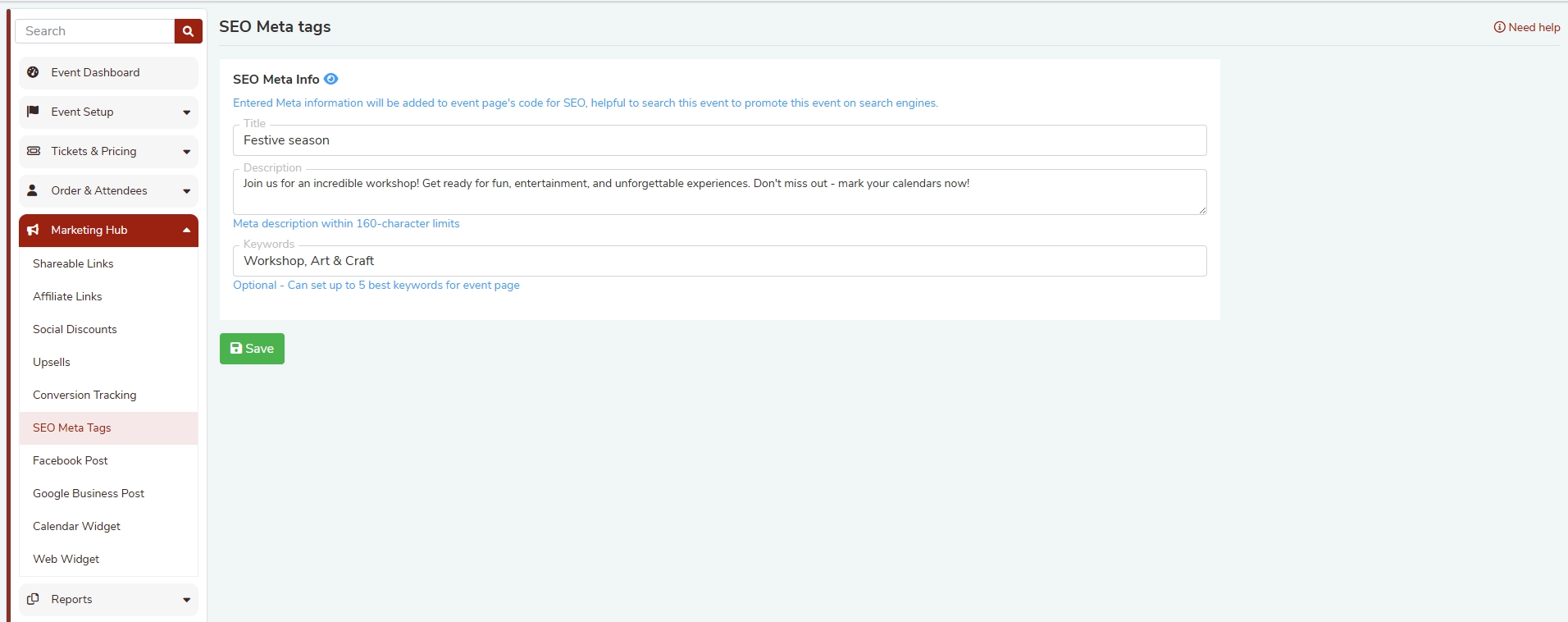
In FEARTICKET, you can configure three meta tag fields:
- Title - The headline that appears in search engine results.
- Description - A short summary shown beneath the title in search results.
- Keywords - Relevant terms that help search engines categorize your event.
Frequently Asked Questions
Where can I find the SEO Meta Tags setting?
Navigate to your Event Dashboard, then Marketing Hub, then SEO Meta Tags. This section is available for every event you create in FEARTICKET.
What should I enter in the Title field?
Enter a clear, concise name for your event, ideally including the event name and location or type. For example:
Festive Season Haunted House - Houston, TX
A strong SEO title:
- Is unique to your event
- Includes primary keywords (e.g., haunted house, Halloween attraction)
- Is typically 50 to 60 characters long for best display in search results
What is the Meta Description and how long can it be?
The Meta Description is a short paragraph (up to 160 characters) that summarizes your event. It appears beneath the title in Google search results and can influence whether a user clicks on your link.
Tips for a great meta description:
- Mention the event type, highlights, and a call to action
- Keep it under 160 characters (FEARTICKET will warn you if you exceed this)
- Example: Join us for an incredible workshop! Get ready for fun, entertainment, and unforgettable experiences. Don't miss out - mark your calendars now!
Meta descriptions longer than 160 characters may be truncated by search engines.
What are Keywords and how many can I add?
Keywords are words or short phrases that describe your event and help search engines categorize it. FEARTICKET allows you to add up to 5 keywords for each event page.
Choose keywords that your target audience is likely to search for. Examples:
- Haunted House
- Halloween Tickets
- Workshop, Art and Craft
- Escape Room Houston
- Horror Festival 2026
Pro Tip: Use specific, niche keywords rather than overly broad ones. For example, "Haunted House Dallas" will attract more relevant traffic than just "events".
Does filling in SEO Meta Tags guarantee my event appears on Google?
Filling in SEO Meta Tags significantly improves the chances of your event being indexed and appearing in search results, but it does not guarantee a specific ranking. Search engine rankings depend on many factors, including:
- Domain authority of your event page
- Quality and relevance of your content
- Competition for the same keywords
- Number of external links pointing to your page
Using well-crafted meta tags is one of the most impactful steps you can take to boost your event's online visibility.
How do I save my SEO Meta Tag information?
After filling in the Title, Description, and Keywords fields, click the green Save button at the bottom of the SEO Meta Info section. Your metadata will be immediately applied to your event page's code.
Can I update SEO Meta Tags after my event is published?
Yes. You can return to Marketing Hub, then SEO Meta Tags at any time to update your title, description, or keywords. Click Save after making any changes. Updates may take a short time to be re-indexed by search engines.
Are SEO Meta Tags available for all event types?
Yes. The SEO Meta Tags feature is available for all events created on FEARTICKET, regardless of the schedule type (Time-Ticketing, Date-Range, or Recurring Schedule).
Best Practices Summary
| Field | Recommended Length | Best Practice |
|---|---|---|
| Title | 50 to 60 characters | Include event name and type or location |
| Description | Up to 160 characters | Summarize the event with a call to action |
| Keywords | Up to 5 keywords | Use specific, audience-relevant terms |
Was this article helpful?
That’s Great!
Thank you for your feedback
Sorry! We couldn't be helpful
Thank you for your feedback
Feedback sent
We appreciate your effort and will try to fix the article