Ticketing Rules in FEARTICKET allow event organizers to control how tickets are purchased together. You can enforce purchase requirements, restrict combinations, or unlock special tickets based on what a buyer already has in their order.
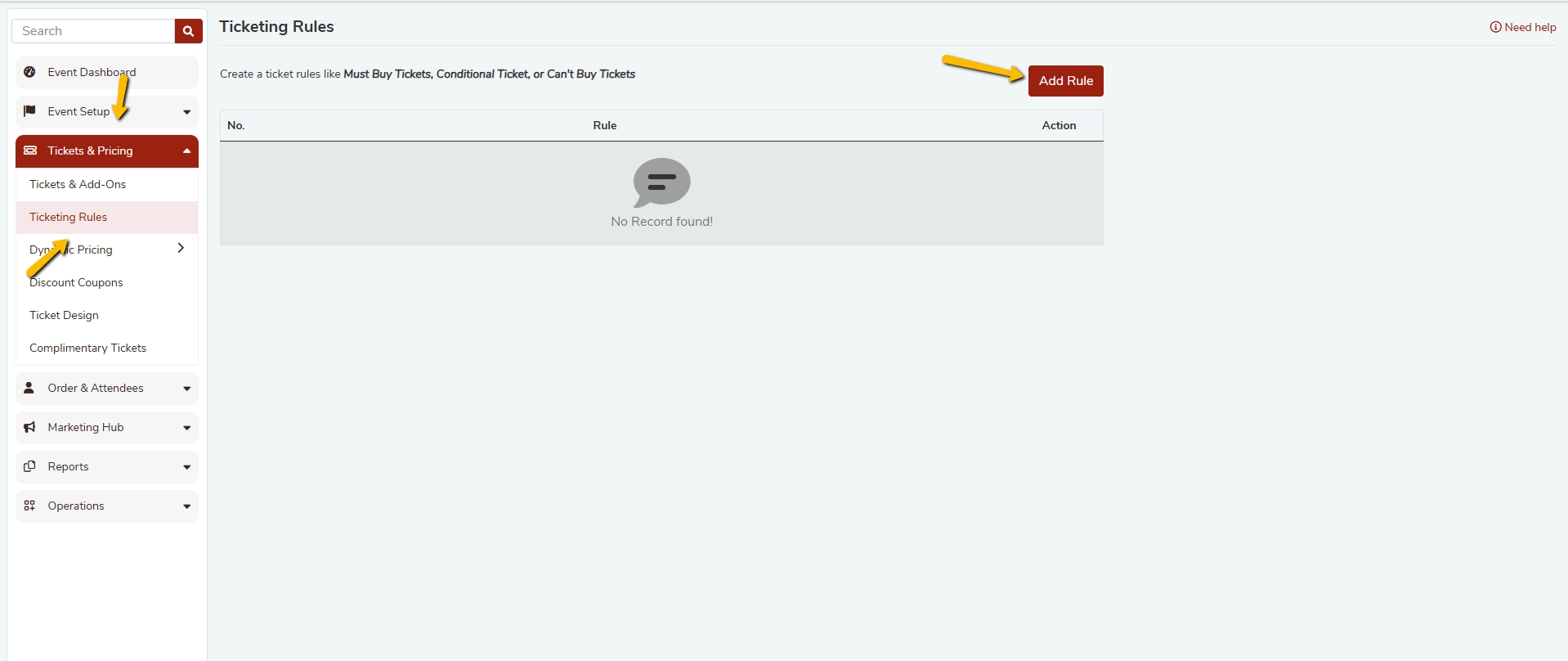
Where to find it: Go to your Event Dashboard > Tickets & Pricing > Ticketing Rules
What Are Ticketing Rules?
Ticketing Rules let you define conditional logic around ticket purchases. You can create rules that:
- Require a specific ticket to be bought alongside another.
- Conditionally unlock a ticket only when certain criteria are met.
- Block a ticket from being purchased if another ticket is already in the cart.
These rules help you manage bundle requirements, age-restricted tickets, upsells, and mutually exclusive ticket combinations.
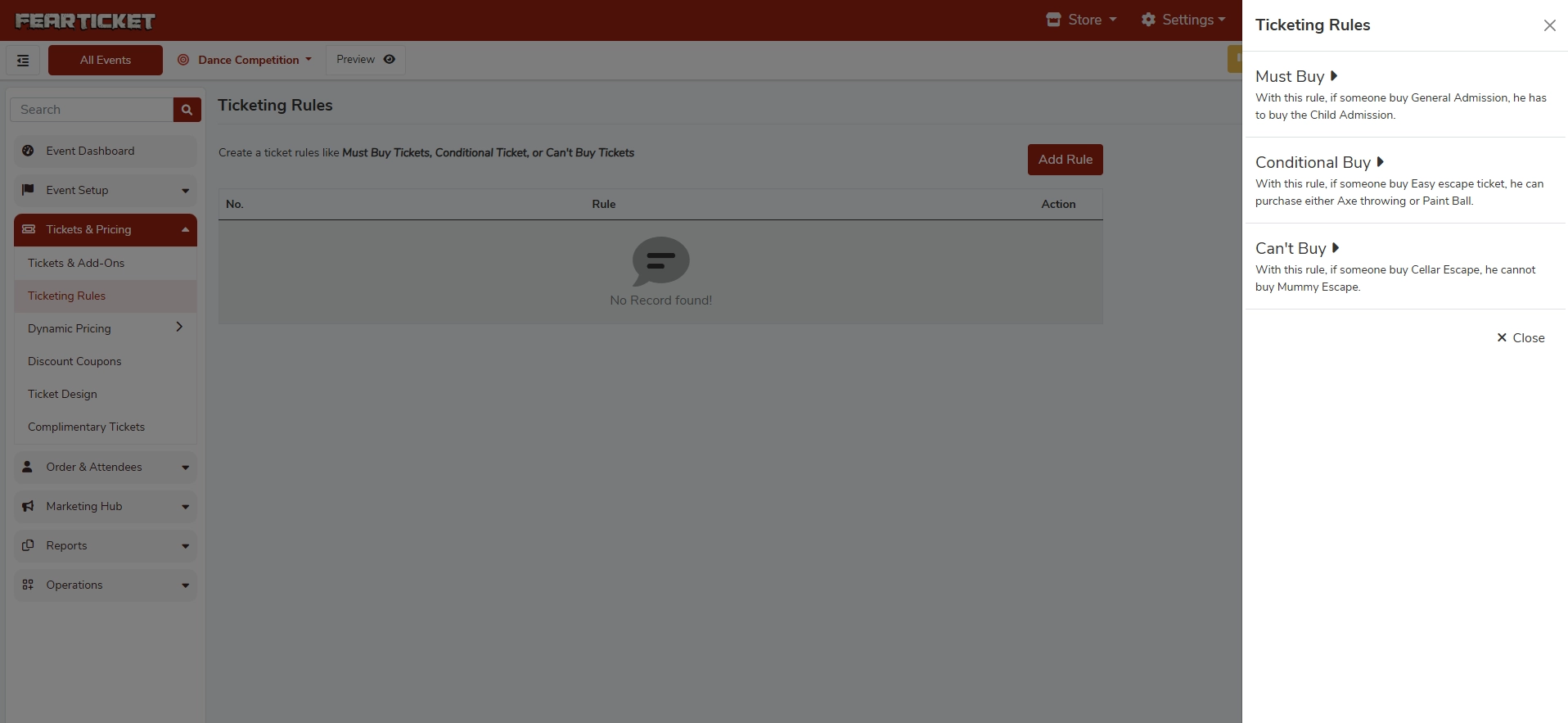
Types of Ticketing Rules
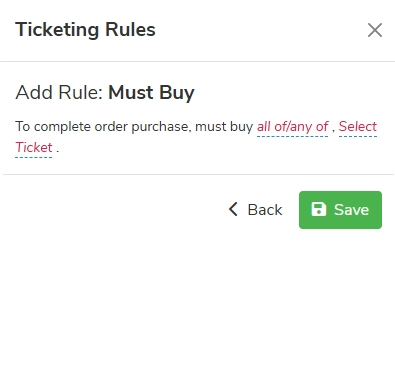
1. Must Buy
What it does: Forces the buyer to include a specific ticket (or set of tickets) in their order before they can complete their purchase.
How it works:
To complete the order purchase, the buyer must buy all of / any of the selected ticket(s).
- All of - Every ticket in the list must be included in the order.
- Any of - At least one ticket from the list must be included.
Common use cases:
- Requiring a General Admission ticket alongside a VIP upgrade.
- Mandating a base ticket before an add-on (e.g., parking pass, fast pass) can be purchased.
- Ensuring a child ticket is always paired with an adult ticket.
Example:
With this rule, if someone buys General Admission, they must also buy the Child Admission.
2. Conditional Buy
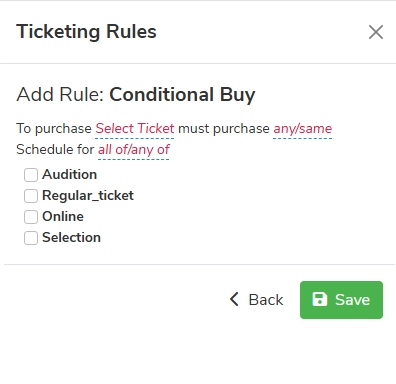
What it does: Unlocks or makes a ticket purchasable only when the buyer selects a specific ticket AND chooses a matching schedule (time slot/date).
How it works:
To purchase the [selected ticket], the buyer must also purchase any/same schedule for all of / any of the specified tickets.
- Any Schedule - The buyer can choose a different time slot for the conditional ticket.
- Same Schedule - The buyer must select the exact same time slot for both tickets.
Common use cases:
- Offering an escape room add-on only when a main event ticket is purchased.
- Unlocking a backstage pass only when a specific performance ticket is selected for the same time slot.
- Making a paint ball session available only alongside a specific activity ticket.
Example:
With this rule, if someone buys an Easy Escape ticket, they can then purchase either the Axe Throwing or Paint Ball ticket.
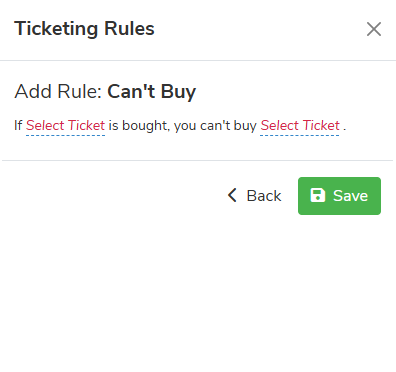
3. Can't Buy
What it does: Prevents the buyer from purchasing a specific ticket if a certain other ticket is already in their cart.
How it works:
If [Ticket A] is bought, the buyer cannot buy [Ticket B].
Common use cases:
- Preventing conflicting ticket types from being purchased together (e.g., a kids-only ticket and an adults-only ticket).
- Blocking a discounted ticket from being combined with another discount.
- Ensuring mutually exclusive experiences are not double-booked.
Example:
With this rule, if someone buys a Cellar Escape ticket, they cannot also buy the Mummy Escape ticket.
How to Add a Ticketing Rule
- Go to Event Dashboard > Tickets & Pricing > Ticketing Rules.
- Click the Add Rule button in the top-right corner.
- A side panel will appear with three rule type options:
- Must Buy
- Conditional Buy
- Can't Buy
- Select the rule type you want to create.
- Configure the rule by selecting the relevant tickets using the Select Ticket dropdowns.
- For Conditional Buy, also specify whether the schedule should be any or same, and select the qualifying tickets.
- Click Save to activate the rule.
Tip: You can use the Back button at any time to return to the rule type selection without losing your progress.
Frequently Asked Questions
Where do I find Ticketing Rules in FEARTICKET?
Ticketing Rules are located under Tickets & Pricing in the left-hand navigation of your Event Dashboard. Click on Ticketing Rules to view, add, or manage rules for your event.
Can I add multiple rules to a single event?
Yes. You can create as many Ticketing Rules as needed for your event. All active rules will be listed in the Ticketing Rules table with their rule number and description.
What happens if no rules are set up?
If no rules are configured, the page will display "No Record found." Buyers will be able to purchase any ticket independently without restrictions.
What is the difference between "All of" and "Any of" in a Must Buy rule?
- All of means the buyer must include every ticket listed in the rule.
- Any of means the buyer only needs to include at least one ticket from the list.
What is the difference between "Any Schedule" and "Same Schedule" in a Conditional Buy rule?
- Any Schedule allows the buyer to select a different time slot for the conditional ticket than the original.
- Same Schedule requires the buyer to pick the exact same time slot for both tickets.
Can I use Ticketing Rules to prevent two discounted tickets from being used together?
Yes. Use the Can't Buy rule to block one ticket from being purchased when another specific ticket is already in the cart.
Are Ticketing Rules enforced at checkout?
Yes. Rules are enforced during the ticket selection and checkout process. Buyers will be guided or restricted based on the rules you've configured.
Can I delete or edit a Ticketing Rule after saving it?
Yes. You can manage (edit or delete) existing rules directly from the Ticketing Rules table using the Action column.
Do Ticketing Rules apply to both online and box office sales?
Yes. Ticketing Rules apply across all sales channels, including your online store and box office.
Was this article helpful?
That’s Great!
Thank you for your feedback
Sorry! We couldn't be helpful
Thank you for your feedback
Feedback sent
We appreciate your effort and will try to fix the article