Facebook, is one of the most popular social media platforms. It helps to reach several people and is the best platform to sell your event online. It also helps you track the behavior user. You can track the conversion by Facebook pixel.
Facebook Pixel
Facebook Pixel helps you to track ticket buyer activity. It also helps you to understand the behaviour of the ticket purchase process. Generate the Pixel code from your Facebook account. Go to Marketing Hub -> Conversion Tracking. Set the Pixel code (usually 15-16 characters). You can get more info to generate the Pixel Code click here. 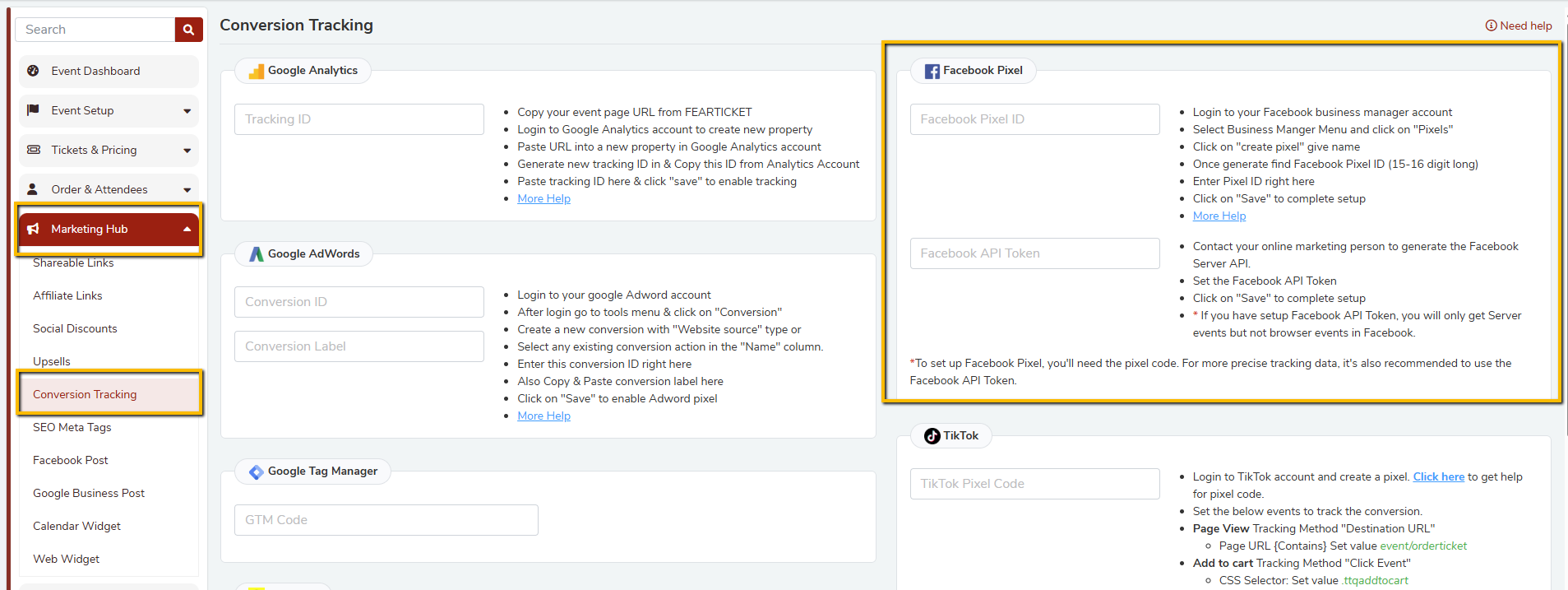
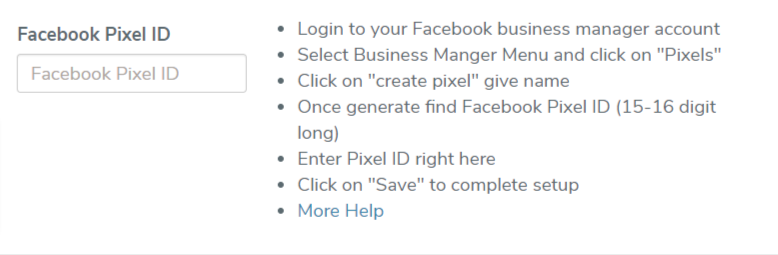 Note: To set up Facebook Pixel, you'll need the pixel code. For more precise tracking data, it's also recommended to use the Facebook API Token.
Facebook API Token
FACEBOOK API token is the most recommended method to trek the conversion data. To trek your event conversion, copy the API Token from your FACEBOOK Business Account set in the Facebook API Token field and save it. After you save it your event will start sending the data to your Facebook account.
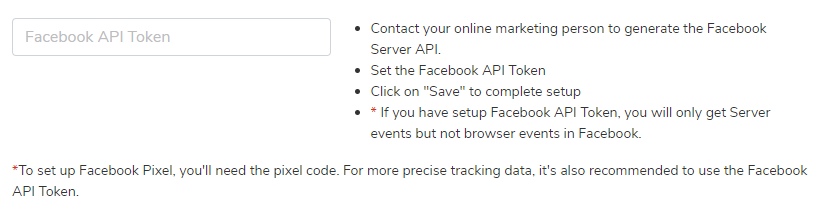
Please Note: Facebook API Token is the most recommended method for conversion tracking.
Here is the information of data that, FEARTICKET will send you through FB API Token on each individual action the user performs while purchasing a ticket.
When user arrive on your event ticketing page.
// Landing Page
Custom parameters sent
action_source: website
content_name: Event View
custom_data: Show
event_id: 1845
event_name: View content
event_source_url: Show
event_time: 1724929053
user_data: Show
Event Info
Setup Method: Manual
URL called: Show
Load Time: 489.67 ms
Pixel Location: Show
When user add tickets into the cart.
// Item added into the cart
Custom parameters sent
action_source: website
custom_data: Hide
{"content_name":"Item added into the cart","currency":"USD","value":80}
event_id: 1845
event_name: Add to cart
event_source_url: Hide
https://classicghostevent.fearticket.com/frontapp
event_time: 1724990948
user_data: Hide
{"client_ip_address":"122.170.96.238","client_user_agent":"Mozilla/5.0 (Windows NT 10.0; Win64; x64) AppleWebKit/537.36 (KHTML, like Gecko) Chrome/128.0.0.0 Safari/537.36"}
Event Info
Setup Method: Manual
URL called: Show
Load Time: 39.09 ms
Pixel Location: Hide
https://classicghostevent.fearticket.com/frontapp
While the user initiates the checkout process
//Checkout Initiated
Custom parameters sent
action_source: website
custom_data: Hide
{"content_name":"Checkout Initiated","order_id":4456351,"contents":[{"id":5461778,"quantity":1,"item_price":80}],"currency":"USD","value":"80.00"}
event_id: 4456351_2'
event_name: Initiate checkout
event_source_url: Show
event_time: 1724991137
num_items: 1
user_data: Show
While the User proceeds for the payment
// Order Payment
Custom parameters sent
action_source: website
custom_data: Hide
{"content_name":"Order Payment","order_id":4456351,"contents":[{"id":5461778,"quantity":1,"item_price":80}],"currency":"USD","value":"80.00"}
event_id: 4456351_3'
event_name: Add payment
event_source_url: Show
event_time: 1724991137
num_items: 1
user_data: Show
Event Info
Setup Method: Manual
URL called: Show
Load Time: 249.16 ms
Pixel Location: Show
And, at last when the order is placed successfully.
// Order Placed
Custom parameters sent
action_source: website
custom_data: Hide
{"content_name":"Order Placed","status":"Order Successful","contents":[{"id":5461814,"quantity":1,"item_price":80}],"currency":"USD","value":0}
event_id: 4456386#_4'
event_name: Purchase
event_source_url: Show
event_time: 1724993088
num_items: 1
order_id: 4456386
user_data: Show
Event Info
Setup Method: Manual
URL called: Show
Load Time: 34.91 ms
Pixel Location: Show
As you can see in every conversion request, there is a parameter "Event_Name". That helps you identify the action taken by the buyer.
Conversion Tracking Errors – Question & Answer Guide
This document explains common Meta conversion tracking errors related to Meta Pixel and Meta Conversions API (CAPI), their causes, and solutions. It is designed for marketing, analytics, and technical teams to quickly diagnose and fix tracking issues.
1. What is Meta Pixel and why is it important?
Answer:
Meta Pixel is a JavaScript code placed on your website that tracks user actions (events) such as PageView, ViewContent, AddToCart, InitiateCheckout, and Purchase. These events help Meta Ads:
Measure ad performance
Optimize ad delivery
Build custom and lookalike audiences
Official documentation:
2. What is Meta Conversions API (CAPI)?
Answer:
Meta Conversions API allows you to send conversion events directly from your server to Meta instead of relying only on browser-based tracking. It improves data reliability by reducing data loss caused by:
Ad blockers
Browser tracking prevention (ITP)
Cookie restrictions
Official documentation:
3. What is the difference between Meta Pixel and Conversions API?
Answer:
Meta Pixel | Conversions API |
Browser-based | Server-based |
Affected by ad blockers | Less affected by blockers |
Easier to set up | Requires backend integration |
Real-time browser events | More reliable event delivery |
Best practice: Use Pixel + CAPI together for optimal tracking.
Official documentation:
4. What are common Meta conversion tracking errors?
Answer:
Common errors include:
Purchase event not firing
Events not appearing in Events Manager
Deduplication issues
Missing or invalid parameters
Domain verification errors
Event match quality warnings
5. Why is the Purchase event not tracking or showing in Meta (Pixel & CAPI)?
Answer:
This is one of the most common Meta conversion issues. Purchase may not track due to frontend, backend, or configuration problems.
Common Reasons
Purchase event fires on a different domain or payment gateway
Thank-you / success page is not loading or skipped
Event fires before payment confirmation
Pixel blocked by browser, ad blocker, or consent banner
Purchase is sent only via CAPI, so Pixel Helper does not show it
Event rejected due to invalid parameters
Missing or mismatched event_id (Pixel + CAPI)
How to Identify the Root Cause
Check Meta Events Manager → Diagnostics
Use Test Events tool with a test code
Confirm whether Purchase is coming from Browser, Server, or both
Verify the thank-you page URL loads after payment
Possible reasons:
Purchase event fires on a different domain or subdomain
Event fires before payment confirmation
JavaScript error on the thank-you page
Pixel is blocked by browser or ad blocker
Event is triggered via server (CAPI only)
Solution:
Verify the thank-you page URL
Check console errors
Confirm event trigger conditions
Cross-check with Events Manager
Official documentation:
6. Purchase shows in Pixel Helper but not in Events Manager – Why?
Answer:
If Purchase appears in Pixel Helper but not in Events Manager, Meta is receiving the event but rejecting it.
Possible Causes
Invalid or missing parameters (value, currency, content_ids)
Incorrect event name (must be exactly Purchase)
Invalid timestamp (event_time too old or in future)
Domain not verified
Solution
Ensure standard parameters are passed correctly
Verify domain in Business Manager
Check Diagnostics for rejected events
Answer:
This usually happens when:
Event is fired but rejected by Meta
Event parameters are invalid
Timestamp is incorrect
Event name does not match standard Meta events
Check Diagnostics tab in Events Manager
Ensure correct event names and parameters
Validate event payload structure
Official documentation:
7. What is event deduplication and why does it cause issues?
Answer:
When both Pixel and CAPI send the same event, Meta uses event_id to deduplicate. If:
event_id is missing
event_id does not match between Pixel and CAPI
Meta may:
Count events twice
Ignore one event
Solution:
Use the same event_id for both Pixel and CAPI
Official documentation:
8. What is Event Match Quality and why is it low?
Answer:
Event Match Quality indicates how well Meta can match events to users. Low quality occurs when:
Missing user data (email, phone, IP, user agent)
Data not hashed correctly (SHA-256 required)
Solution:
Send advanced matching parameters
Ensure proper hashing for user data
Official documentation:
9. Purchase not tracking via Conversions API (CAPI)
Answer: Purchase events sent via CAPI may fail silently if payload or authentication is incorrect.
Common CAPI Purchase Errors
Invalid or expired access token
Incorrect pixel_id
Missing required fields: event_name, event_time, action_source
Server timezone mismatch
Improper JSON format
Missing or mismatched event_id (deduplication issue)
Solution
Validate token and pixel ID
Follow Meta Purchase event schema strictly
Send same event_id from Pixel and CAPI
Test using Test Events tool
Official documentation:
10. How to debug Meta conversion errors effectively?
Answer: Use these tools together:
Meta Pixel Helper (browser extension)
Events Manager → Diagnostics
Test Events tool
Server logs (for CAPI)
Official documentation:
11. Best practices to avoid Meta conversion tracking issues
Answer:
Implement Pixel + CAPI together
Always use event_id for deduplication
Verify domains
Use standard Meta event names
Monitor Diagnostics regularly
Test events before launching ads
Official documentation:
12. Event Corrupt Issue
What does “Event Corrupt” mean?
An event is marked Corrupt when Meta receives it but cannot process it due to missing, invalid, or incorrectly formatted data.
Corrupt events are ignored and do not count toward conversions or ad optimization.
Common causes of corrupt events
Missing required parameters
(event_name, event_time, action_source)
Incorrect data types
(e.g., value sent as text instead of number)
Invalid currency format
(must be ISO code like USD)
Incorrect timestamps
(too old, future-dated, or wrong timezone)
Improper hashing of user data
(SHA-256 is required)
Malformed JSON payload (CAPI)
Invalid or expired access token
Incorrect Pixel ID
Pixel vs CAPI: corrupt event differences
Pixel-related
JavaScript errors
Missing parameters on page load
Event firing too early
CAPI-related
Payload schema mismatch
Server time zone mismatch
Authentication issues
Improper JSON formatting
How to identify corrupt events
Open Meta Events Manager
Go to Diagnostics
Look for:
“Corrupt events”
“Rejected events”
Use Test Events tool
For CAPI, check server logs
Step-by-step fix checklist
Use standard Meta event names only
Validate event_time (Unix timestamp, seconds)
Send numeric value and valid currency
Hash user data correctly (SHA-256)
Verify access token & pixel ID
Retest using Test Events
Monitor Diagnostics after deployment
Best practices to avoid corruption
Validate payloads before sending
Test every update in Test Events
Monitor Diagnostics weekly
Avoid custom event names unless necessary
Official Meta documentation for event corruption
Conversions API Error Handling
https://developers.facebook.com/docs/marketing-api/conversions-api/using-the-api/#error-handling
Events Manager Diagnostics
https://www.facebook.com/business/help/898185560232180
Summary
Meta conversion errors are usually caused by misconfiguration, missing parameters, or incorrect event flow. Proper implementation, testing, and regular monitoring using Meta’s official tools can prevent most issues and ensure accurate conversion tracking.
Was this article helpful?
That’s Great!
Thank you for your feedback
Sorry! We couldn't be helpful
Thank you for your feedback
Feedback sent
We appreciate your effort and will try to fix the article