FEARTICKET lets you change the price of a ticket depending on the actual calendar date someone buys it. This is useful for early bird pricing, where anyone who purchases before a set date pays less than someone who buys later.
In Tickets & Pricing, click on Rule Builder. Under the template list, find Based on Purchased Date and click Use this rule, as shown in the image below.
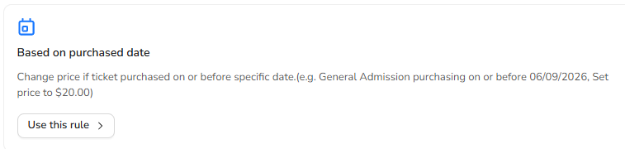
The Based on Purchased Date template, found in the Rule Builder template list.
What Happens When You Open This Rule
Clicking Use this rule opens the rule builder with two conditions already started for you: one for the Ticket, and one for the Purchase Date. At the top you can also name the rule, and there is a checkbox for Stop processing further rules if this matches, which you can use if you don't want other rules to run once this one applies.
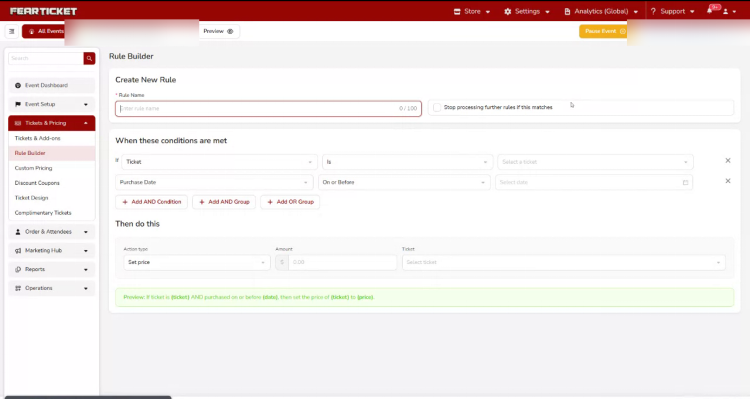
The rule builder screen that opens when you select Based on Purchased Date, with the Ticket and Purchase Date conditions pre-filled.
Setting the Ticket
The first row lets you choose which ticket the rule should check. Set the field to Ticket, then choose an operator. Is checks a single ticket type. Any Of lets you select more than one ticket type at once, so the rule applies to several tickets together. After choosing the operator, select the ticket or tickets from the dropdown.
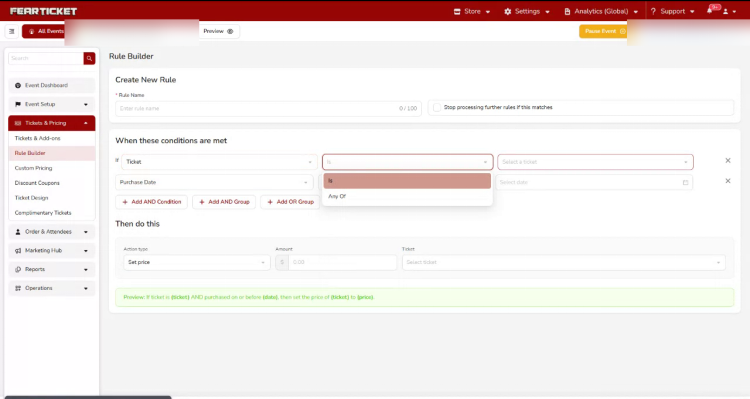
Choosing Is or Any Of when setting the Ticket condition.
Setting the Purchase Date
The second row is where this rule gets its name. The field is set to Purchase Date, and the template sets the operator to On or Before by default. This means the price only applies if someone buys the ticket on or before the date you choose. Click the date field to open a calendar and pick the cutoff date.
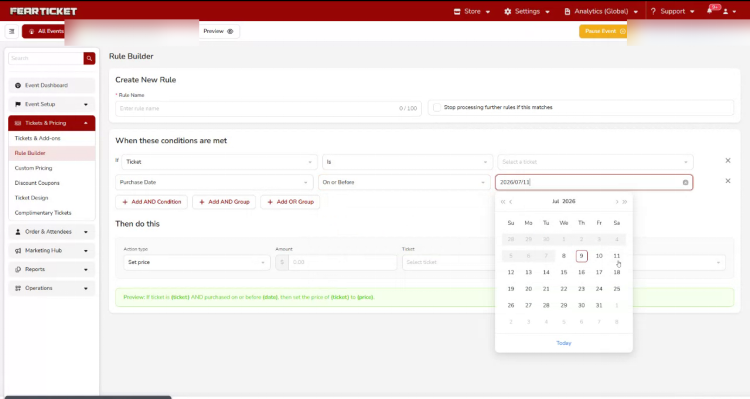 Selecting the cutoff date using the calendar picker.
Adding More Conditions (Optional)
If you want the rule to depend on more than just the ticket and the purchase date, you can change or add a field. Clicking into the field dropdown shows the full list of options: Purchase Date, Day of Week, Days Before Event, Ticket Quantity, Cart Quantity, Ticket Sold, and Ticket Sold (%). Each of these comes with its own set of operators, for example Ticket Quantity and Ticket Sold use numeric comparisons like Greater than or Equal to and Less than or Equal to, while Day of Week uses Is or Any Of, similar to the Ticket field.
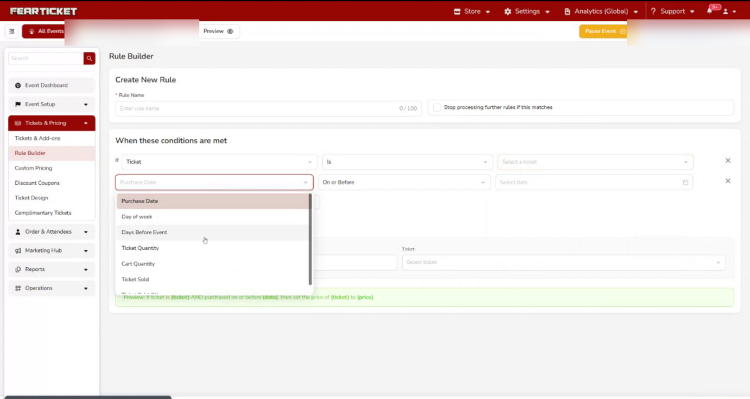 The full list of fields available for building a condition.
You can also use Add AND Condition, Add AND Group, or Add OR Group to combine several of these fields into one rule. AND Condition and AND Group both require everything inside them to be true at the same time, while an OR Group gives the rule an alternate path, so it still applies even if the main conditions aren't met but the OR Group is.
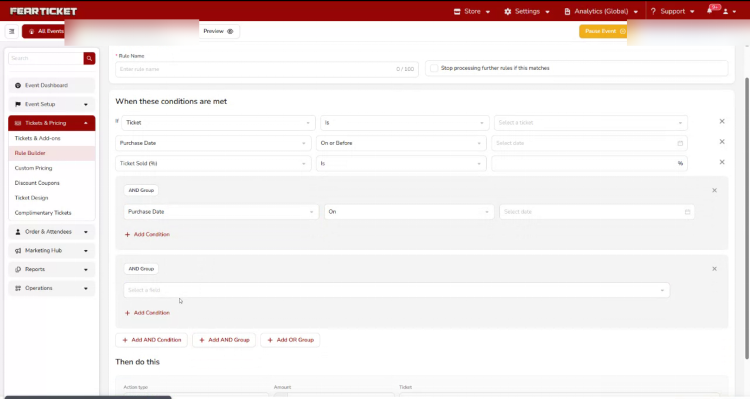 Adding AND Group and OR Group blocks to build a more advanced version of this rule.
Setting the Price
Under Then do this, the Action type is set to Set price by default, but it's worth opening that dropdown, since it holds more than just pricing changes. The options are grouped into three categories:
Pricing: Set price, Increase price, and Decrease price. Set price replaces the ticket's price outright. Increase price and Decrease price adjust it up or down from whatever it's currently set to.
Dependency: Must buy and Can't buy. Must buy forces a second ticket to be purchased alongside this one. Can't buy blocks a ticket from being purchased together with another one.
BOGO: Buy X get Y free, which gives someone additional tickets for free once they buy a certain quantity.
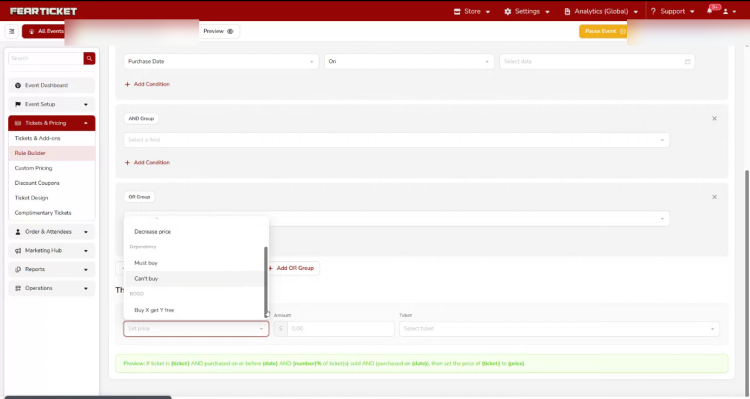 The full list of Action types, grouped into Pricing, Dependency, and BOGO.
For a purchase-date rule you'll typically stick with Set price. Once that's selected, enter the Amount, then use the Ticket dropdown to choose which ticket the new price applies to.
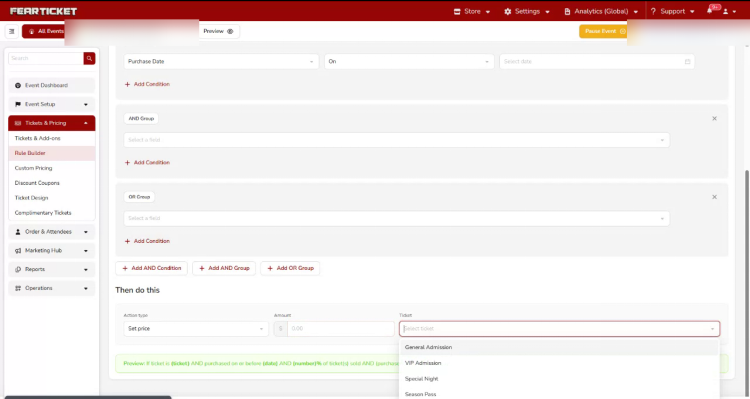 Choosing which ticket the new price applies to.
Reading the Preview Before You Save
FEARTICKET writes a plain English summary of the rule right above the Save button, and it updates automatically as you add or change conditions. For the basic setup described above, it would read:
If ticket is (ticket) AND purchased on or before (date), then set the price of (ticket) to (price).
It's worth reading this line before saving, since it's the easiest way to catch a mistake.
Example
If General Admission is purchased on or before 06/09/2026, set price to $20.00. Once saved, anyone who buys General Admission on or before that date automatically pays $20. After that date, the ticket goes back to its regular price unless another rule says otherwise.
Note: This rule only affects the ticket type you select in it. Other ticket types keep their regular pricing unless a separate rule is created for them.
Was this article helpful?
That’s Great!
Thank you for your feedback
Sorry! We couldn't be helpful
Thank you for your feedback
Feedback sent
We appreciate your effort and will try to fix the article