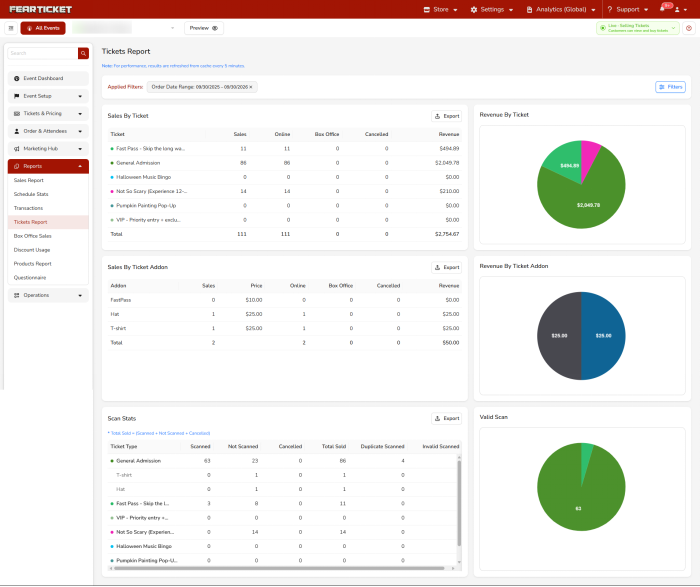
FEARTICKET gives you a complete picture of ticket and add-on sales, revenue, and scan activity in the Tickets Report. Each section pairs a data table with a pie chart, so you can read the numbers and see the split at a glance. This article walks through the page and its filters.
To open it, go to Reports in the left-hand menu of your event and click Tickets Report. A note at the top reminds you that results are refreshed from cache every 5 minutes, so very recent sales may take a few minutes to appear.
Filtering the Report
At the top, Applied Filters shows which filters are active as removable chips, and the Filters button opens the filter window.
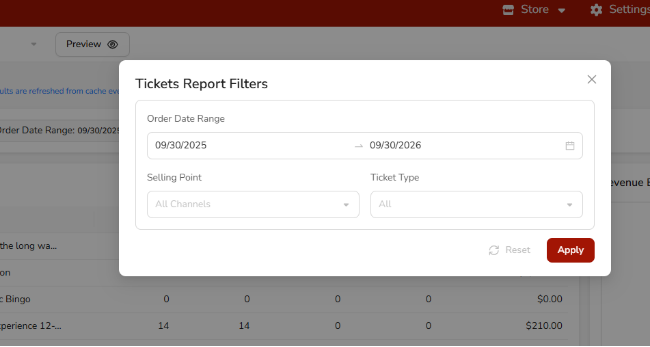
Order Date Range
Set the period the report covers. You can type a start and end date or use the calendar with quick presets such as Today, Yesterday, Last 7 Days, Last 30 Days, This Month, Last Month, or a Custom Range.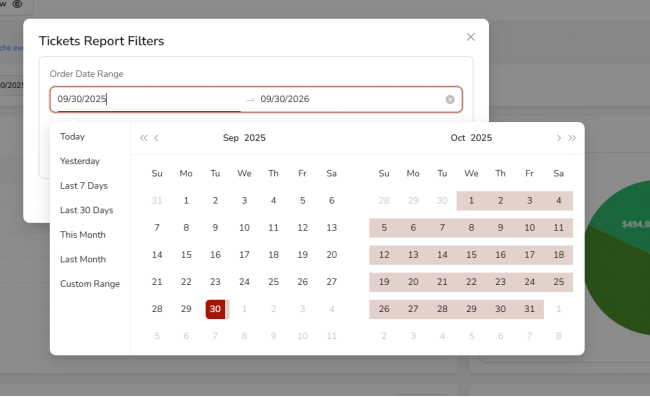
Selling Point
Filter by where tickets were sold. All Channels shows everything, or you can narrow it to just Online or just Box Office.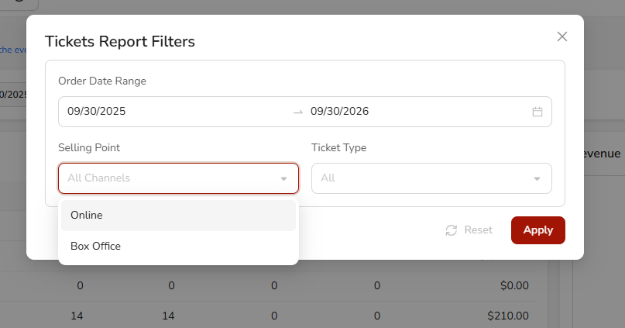
Ticket Type
Filter by the kind of ticket, such as Free Tickets, Regular Tickets, Donation Tickets, Combo Tickets, or Private Booking, or leave it on All.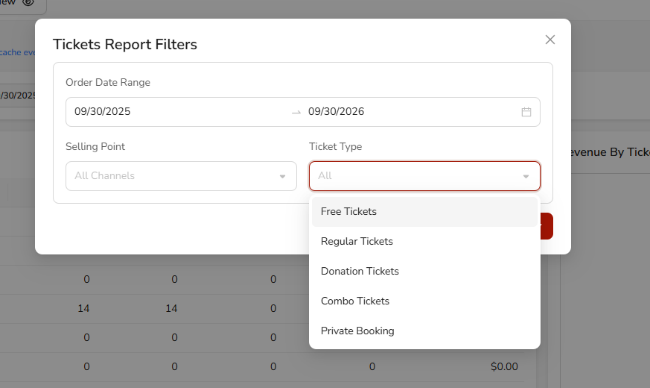
After setting the filters, click Apply to update the report, or Reset to clear them.
Sales By Ticket
The Sales By Ticket table breaks down performance by individual ticket type, with a Total row at the bottom. Alongside it, the Revenue By Ticket pie chart shows each ticket type's share of revenue. The columns are:
Column | What It Shows |
Ticket | The name of the ticket type |
Sales | Total tickets sold for that type |
Online | Number sold through the online portal |
Box Office | Number sold at the box office |
Cancelled | Number of cancellations for that type |
Revenue | Total revenue generated by that type |
Sales By Ticket Addon
The Sales By Ticket Addon table shows the same kind of breakdown for add-ons (upsells) attached to your tickets, such as a T-shirt or Hat, with its own Price column. The Revenue By Ticket Addon pie chart next to it shows how revenue splits across add-ons.
Scan Stats
The Scan Stats table shows check-in and scanning activity for each ticket and add-on type, which is especially useful for monitoring the gate during your event. The Valid Scan pie chart beside it visualizes successful scans. Note that Total Sold equals Scanned plus Not Scanned plus Cancelled. The columns are:
Column | What It Shows |
Ticket Type | The ticket or add-on being scanned |
Scanned | Tickets successfully scanned or checked in |
Not Scanned | Valid tickets not yet scanned |
Cancelled | Cancelled tickets |
Total Sold | Total tickets sold (Scanned + Not Scanned + Cancelled) |
Duplicate Scanned | Tickets scanned more than once, flagged as duplicates |
Invalid Scanned | Scan attempts that were invalid or failed |
Keep an eye on Duplicate Scanned to catch potential ticket fraud or scanner errors at the gate.
Exporting the Report
Each section has its own Export button in its top-right corner, so you can download the Sales By Ticket, Sales By Ticket Addon, or Scan Stats data on its own for offline reconciliation or accounting.
Note: The report is cached and refreshes every 5 minutes, so the newest sales and scans may take a short while to appear. If a number looks off right after a change, wait a few minutes and reload the page.
Was this article helpful?
That’s Great!
Thank you for your feedback
Sorry! We couldn't be helpful
Thank you for your feedback
Feedback sent
We appreciate your effort and will try to fix the article